

On a gray afternoon at the train station in Newark, New Jersey, a dozen homeless men and women were panhandling when a large man entered the station without any luggage. Standing in the atrium, he shouted in a booming voice: “If you’re hungry and need a meal, we’ve got free pizza in the park across the street!” He waited as people quietly gathered around him. Then he led a procession to the park for a community meal.
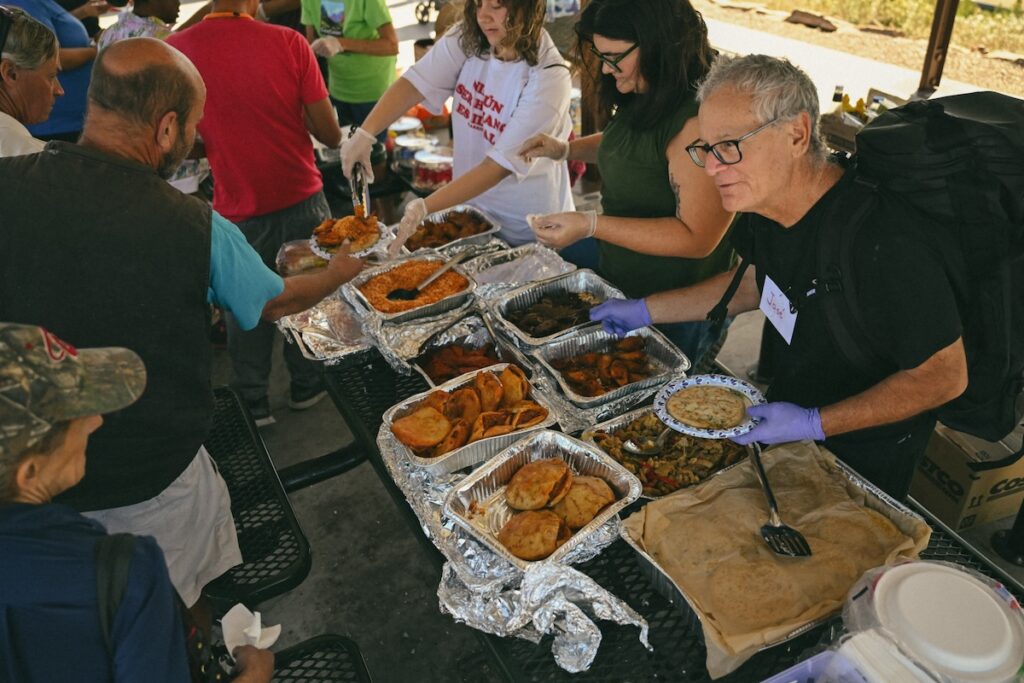
Across the country, from East to West Coast, people like this dedicate their time and money to giving away meals to the hungry. Churches have free breakfasts; volunteers deliver meals; nonprofits host picnics. These everyday acts of generosity, large and small, reflect something deeper: the spirit of voluntary charity woven throughout the fabric of America. The only thing threatening this longstanding American tradition is our own government.
Nourishing Their Neighbors
McKahla Moran had been asleep for just a few hours when her alarm woke her at 5 a.m. one April morning in 2024. She, along with some volunteers, had stayed up for most of the night preparing breakfast burritos to hand out to Dayton, Ohio’s homeless community the next day.
The team had barely begun to hand out burritos when the police came and demanded they shut down the food service immediately.
Over the past decade, Dayton’s homeless population has steadily increased, creating a dire need for more resources than the local government can provide. McKahla set out to bridge those gaps by launching Nourish Our Neighbors (NON) in 2022, offering what the government could not: necessities like socks and hygiene supplies, along with regular meals for the community.
“The thing I love most,” McKahla says, “is watching people’s tangible needs get met and seeing how different they are once they have those tangible needs met.” Her passion for serving her community fuels her and makes operating on a few hours of sleep worth it.
The NON crew packed up the burritos and headed to their regular spot, where the local homeless population expected them to be. No one had any inclination that this routine weekend breakfast service would be cut short by City police.
The team had barely begun to hand out burritos when the police came and demanded they shut down the food service immediately.
Law enforcement claimed that NON had violated a Dayton City ordinance that prohibits handing out food in “central areas of the city,” without a government permit.
As written, the ordinance is vague. Enforcement seems arbitrary, leaving groups like NON unsure whether they are breaking the law when birthday parties and other similar gatherings get a free pass. Applying for a permit also comes with a hefty price tag.
The permit costs $50 per event. But if you happen to have any prior permit violations, you must also pay a $250 security deposit. For smaller groups like NON that exist solely because of the generosity of donors, every dollar that goes toward a permit is money that cannot be spent caring for the homeless.
The officers instructed NON to pack up and move down the street to a local park. This seemed absurd to McKahla, who remembers thinking, Why does the rule change just down the street?
Relocating might not seem like a big deal to law enforcement, but it was a huge deal for NON. The people they serve know to look for them in that spot. McKahla feared someone might miss out on a meal because NON wasn’t in the usual location.
One volunteer was, justifiably, incensed by the situation. He could not in good conscience refuse a meal to a hungry person because of a ridiculous City ordinance. While other NON volunteers spoke with officers, this volunteer handed out a burrito to a man passing by. One officer noticed and ran toward the volunteer, shouting at him to stop, and then proceeded to place the volunteer under arrest.
Eventually, the volunteer was released, but NON was forced to toss 170 perfectly good breakfast burritos in the trash that day—leaving many hungry people unfed.
What happened to NON in Dayton highlights a broader problem happening across the country: Governments increasingly behave as though they hold a monopoly on charity.
Austin in Arizona
For six years, 26-year-old Austin Davis has been running Arizona Hugs (AZ HUGS), a charitable group that provides meals and support for Tempe’s homeless community in a local park. Like McKahla, Austin lives to serve his community.
To Austin, the people who come to his meal services aren’t just recipients of charity; they are his friends. Over the years, he has come to know them on a personal level, understanding their struggles, recognizing their strengths, and even connecting with their families. All too often, communication with loved ones ceases when people start living on the street. Austin has made it a point to connect with his friends’ family members, giving them updates on their safety and keeping the lines of communication open.
Above all, Austin has striven to create a sense of community for Tempe’s most vulnerable. As he says, “The best way for someone to get off drugs or work through their trauma is to create a stable, safe environment where their basic needs are met, and they feel safe enough to trust the people around them.”
Austin’s meal services have made a difference: Tempe even honored him with the “Neighborhood Event of the Year” award in 2022. But in a cruel twist, two years later, the City arrested Austin and banned him from serving his community.
The City of Tempe has a law that requires a “special event” permit for certain public gatherings. To obtain a permit, applicants must pay a $50 application fee, a $100 special event fee “for each day of operation,” and an event space rental fee per day, which ranges from $125 to $1,500 for non-commercial events. Even once these requirements are fulfilled, the City can tack on more permit conditions or even deny the permit if it chooses.
Typically, this law has applied to events like concerts—not meal service for the homeless. Demanding hundreds of dollars per event is unfeasible for nonprofit groups like AZ Hugs, which at one time was serving meals nearly every day of the week. Worse still, anyone who serves meals without a permit faces criminal charges, as Austin learned the hard way.
Austin did his due diligence and applied for a permit but was told by the City that he would have to discontinue meal service for 60 days while his application was pending. Austin felt like the City was putting him in a position where he was forced to choose between his moral responsibility to his community and obeying an arbitrary law. Ultimately, he accepted the risks and continued serving meals.
It was this climate of spontaneous mutual aid that astonished French philosopher and diplomat Alexis de Tocqueville during his visit to America in 1831.
The situation escalated in July 2024, when officers arrested Austin while he was picking up dinner supplies—he hadn’t even gotten to the park yet. Austin was unjustly targeted, treated like a criminal, and forced to spend the night in jail. The next morning, the Tempe Municipal Court judge released him without bail on the condition that he did not step foot in any Tempe public park.
By September 2024, Austin faced 34 charges of trespassing. Despite the risks, he would have continued his meal service, but he didn’t have the financial resources to keep paying citations or fighting in court. Feeling as though he had no other choice, he took a plea bargain to avoid serving more time in jail—all this for committing the sin of permissionless generosity.
It’s not just young activists being targeted by these laws. Even churches, the country’s oldest charitable institutions, are not immune from the criminalization of charity.
In 2016, a church just outside Baltimore, Maryland, was slapped with a $12,000 fine for letting the homeless sleep on its grounds. Similarly, in 2024, an Ohio pastor faced criminal charges for sheltering the homeless in his church.
For a country that once prided itself on our culture of voluntary giving and civil society, it is devastating to witness how far we have strayed from our roots.
Charity Through Compassion, Not Coercion
American charity was born from voluntary moral energy, not bureaucratic design.
When Philadelphia needed a library in 1731, Benjamin Franklin circulated a subscription paper around town, enlisting the help of his fellow townsmen. The subscription model was America’s earliest version of crowdfunding, where everyday people pledged to contribute a given sum to the cause. Franklin, who strongly believed that voluntary, citizen-driven charity was the key to civic virtue, was able to raise 40 shillings upfront and the promise of 10 shillings annually from a pool of 50 people from various social and economic backgrounds. Pooling together for a common cause gave donors a sense of skin in the game, where everyone had a stake in the cause.
This was the first of many subscription libraries in America, and the subscription model itself became a common approach to charity.
Local churches also did their part, collecting from congregants to give back to those in need. Later, in the 1800s, religious groups like the American Tract Society printed pamphlets that encouraged literacy. Ladies’ benevolent circles became the backbone of local charity throughout New England and were later carried to the frontier.
Barn raisings were another charitable staple of rural American communities. Townspeople would pitch in and donate tools and labor to help build barns for their neighbors. These barn raisings weren’t just acts of charity; they were community celebrations. Neighbors came together, bringing food and ale and dancing the night away while local musicians played.
Neighbors gladly gave and took comfort knowing the spirit of civic duty was reciprocal. The neighbor down the road may have fallen on hard times this year, but next year it might be them. They could rest a little easier knowing that their neighbors’ compassion provided a strong social safety net.
It was this climate of spontaneous mutual aid that astonished French philosopher and diplomat Alexis de Tocqueville during his visit to America in 1831.
In the wake of revolution and the Napoleonic Wars, the future of democracy in France was uncertain, but Tocqueville believed it was inevitable. He traveled abroad eager to learn from America’s experiment in democracy and self-government.
America’s emphasis on voluntary, private charity captivated Tocqueville. Unlike France, here people gave freely to those in need out of compassion, and not because of state compulsion or obligation of social class.
Historically, the French aristocracy and clergy class were obligated to give alms to the poor, and they did so—sometimes begrudgingly but always with the expectation that the recipients of them show gratitude and praise.
After the aristocracy was overthrown in the 1789 French Revolution, France moved toward state-sponsored welfare. France’s Bureau de Bienfaisance identified “deserving poor,” scrutinizing families to see which were “worthy” of charity by the state’s standards. It was a bureaucratic and lifeless structure funded through people’s taxes, not through free will. France’s bureaucratic benevolence did not bring communities together or instill a personal sense of moral duty like in American communities. Tocqueville saw America’s voluntary generosity as morally elevating, fostering personal connection and virtue with which state compulsion could not compare. Neighbors helped neighbors without any government mandate, and communities thrived as a result. Bearing witness to the phenomenon, Tocqueville concluded, “Charity is a virtue of the heart, not of the institutions.” When individuals were encouraged to help each other voluntarily, he marveled, “the man who gives and the man who receives are brought nearer together.”
France had sought to make men equal by forcing reliance on the government; America had made men equal by giving them the freedom to rely mutually on each other.
As Tocqueville noted:
Public alms, instead of binding the rich and poor together, breaks the tie which united them. The law strips the poor man of the moral advantage of gratitude, and the rich man of the noble satisfaction of generosity.
While Tocqueville recognized state welfare as well-intentioned, he worried that it would ultimately come at the expense of personal responsibility and compassion, without which a free society would be impossible.
If Tocqueville visited America today, he might be shocked to discover that the government had not only significantly grown the welfare state but had also criminalized the act of helping your neighbor without its permission.
The Government Can’t and Shouldn’t Do It Alone
Tocqueville’s fear that state welfare would suppress society’s sense of moral responsibility is only one piece of the problem.
Even if it wanted to, the government lacks the financial resources and the local knowledge to adequately address the needs of those less fortunate. A City official who has never spent time with Tempe’s homeless will never understand their needs better than someone like Austin, who is out on those streets every day. Governments should be praising and encouraging private individuals to serve their communities instead of arresting them.
Asserting a state monopoly on charity doesn’t just ignore government inadequacy; it also disregards the fact that governments often compound the very problems they pretend to fix.
Housing shortages, for example, have been exacerbated by government interference that restricts property rights and the freedom to build more housing. Zoning, which is meant to enhance public health, welfare, and safety—is instead used to preserve the status quo. Permit fees and exactions—meant to compensate for the actual public impacts of construction—are imposed arbitrarily and unfairly, distorting the housing market and pushing the cost of housing to crippling levels.
The best thing that the government can do is let people help people. Until it does, Pacific Legal Foundation will be fighting to protect Austin and McKahla’s right to serve their communities and honor America’s legacy of individual, permissionless generosity.