

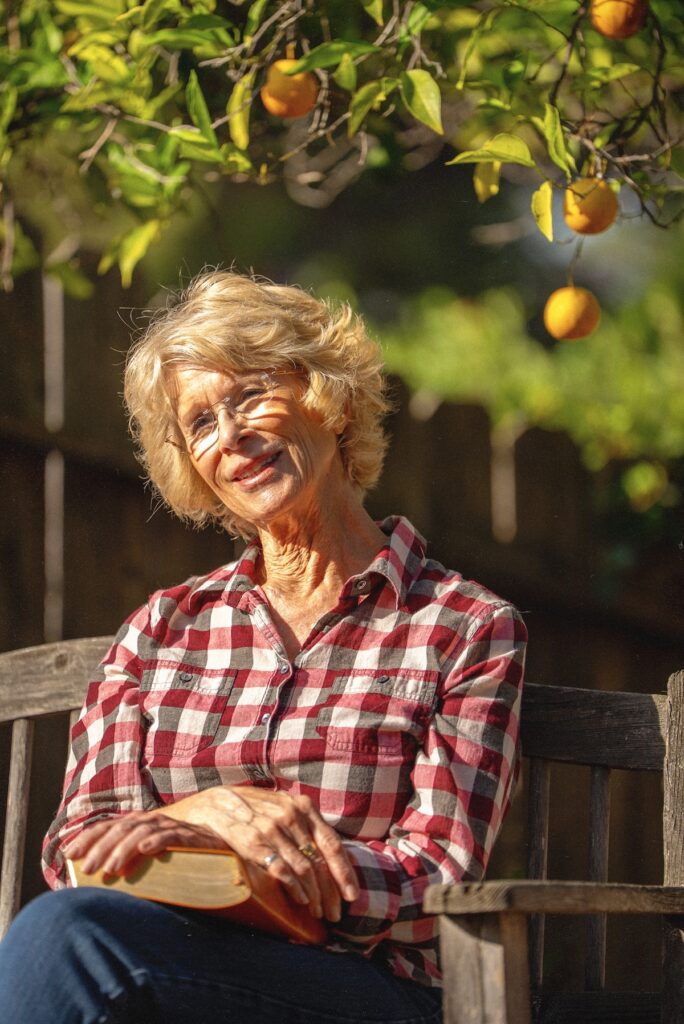
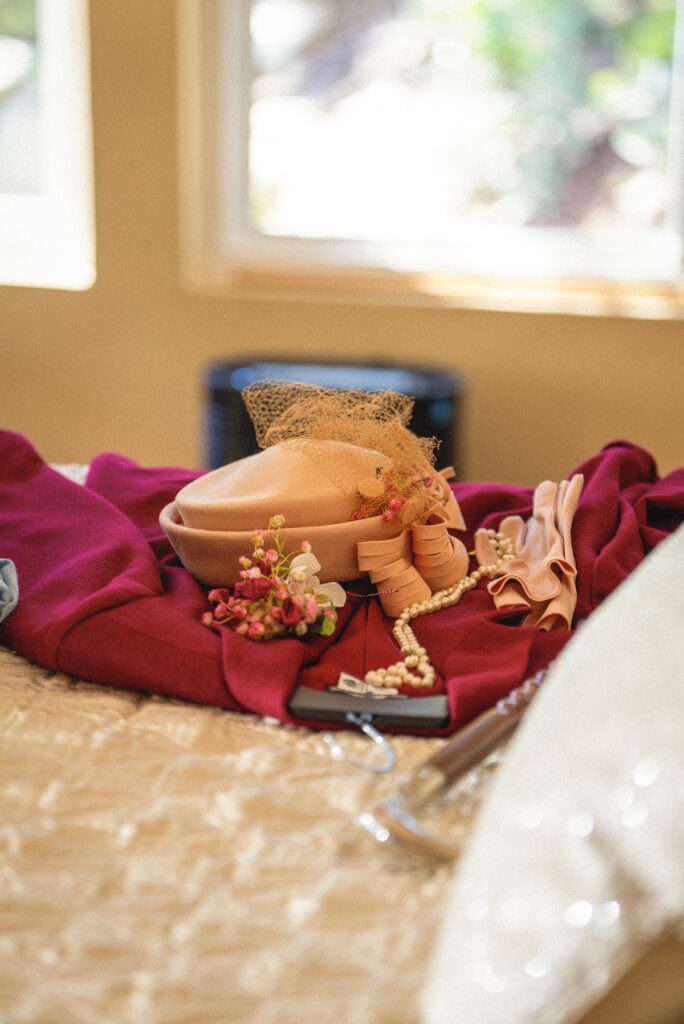
By the time I met Annette Hubbell in person at her sun-dappled home in a San Diego suburb, I’d already watched her on stage: She shared videos from a past performance of her one-woman play, “Women Warriors.” In a series of period costumes—a lace shawl for Elizabeth Fry, the British prison reformer; a deep-purple jacket for Mary McLeod Bethune, the civil rights activist—Annette takes on the personas of women from history who devoted their lives to helping others.
On stage, Annette is simultaneously herself and not-herself. She wears no disguises other than her clothing. Her short bob of curly golden hair is unchanged. But she holds her shoulders differently; she pitches her voice up or down; and, adapting her words from letters, diaries, and witness accounts as much as she can, she speaks from the perspectives of long-dead women to bring their experience and sense of purpose to life.
As Annette’s friend Shelly would later tell me,
She just transforms into these people… The whole stage changes, and it’s the way she walks and the way she’s flamboyantly putting on her hat or taking off her gloves and talking that is—it all comes to life and it just transforms you into being able to feel like you’re talking to that person.
Annette’s play is the reason I flew from Washington, DC, to San Diego to meet her. It’s the reason Pacific Legal Foundation helped Annette file a federal discrimination lawsuit against San Diego County.
Two winters ago, around Christmastime 2023, a county library system invited Annette to perform a selection of her play for Women’s History Month the following March. The manager of the library wanted Annette to portray three women: Harriet Beecher Stowe, Mary McLeod Bethune, and Harriet Tubman.
“I’m an actor, and that’s what we do: We act. We tell stories.”
Annette Hubbell
But a couple weeks before the scheduled performance, Annette got a call from the centralized management of the county library system.
“They asked me to change my characters,” Annette explained in an interview at her house.
I said, “Why?” And they said, “Because two of the characters are black and you are white, and we don’t think that’s appropriate. We think it’s a little bit offensive.” And I said, “Oh, no, you don’t understand, I’m honoring these women.” And she said it didn’t matter… I said, “You mean I can only portray women of honor, courage, and integrity if they’re white?” And she said, “That’s about it.”
‘The Indomitable Human Spirit’
In person, Annette is warm and self-deprecating. Our PLF team and local video crew arrived at her home early in the morning one day at the end of September to start filming. We’d come to produce a short documentary about Annette’s story.
It can be an awkward thing, allowing near-strangers into your home with large blocks of equipment so they can sit you under bright lights and pry into your life. Annette didn’t let it feel awkward. She told us to use any room we liked; she showed us her garden, walking along a path that wound through flowers and dipped under a pepper tree; and she urged us to help ourselves to iced teas and sparkling waters in the fridge. (“You remind me of my aunt,” one of the video crew eventually told her.)
Annette’s play is adapted from her book, Eternity through the Rearview Mirror, which she writes from the perspective of seventeen people who left the world better than it was when they came into it.
“I started with Galileo and I ended with Johnny Cash,” she told me when we sat down for our interview. “I wanted to write about people whose lives could inspire and invigorate and illuminate for us the indomitable human spirit, powered by God.”
It became a play by accident: A friend of Annette’s was organizing an event when the speaker canceled. “Would you talk about the characters in your book?” the friend asked Annette. From there it became a reader’s play—a dramatic reading of book excerpts. Then Annette turned it into a true play, in which she portrays a series of historical female heroes.
Some of Annette’s heroes are black. Sojourner Truth, born into slavery in 1797, went to the New York Supreme Court to fight for the freedom of her five-year-old son, who’d been sold to an Alabama planter. (She won.) Harriet Tubman, born in 1822, rescued so many people from slavery that she was dubbed “Moses.” Mary McLeod Bethune, born on a cotton farm in 1875, sold pies to fund a girls’ school that turned into a full-fledged university in 1941.
When choosing whose stories to tell in her book, Annette says, “I did not take into consideration their station in life, their gender, or the color of their skin. I chose them, to paraphrase Dr. King, for the content of their character.”
The library wanted Annette to replace Harriet Tubman and Mary McLeod Bethune—two of the characters they’d originally requested—with white figures. Someone at the library wasn’t comfortable with the idea of a white woman portraying black women. Annette brought up the musical “Hamilton,” in which black actors portray Founding Fathers. The library official told her it was different.
“And I asked her to explain that,” Annette says, “and she said, ‘I can’t explain it. And frankly, I’m quite puzzled that you don’t understand.’”
Annette was also puzzled.
“I’m an actor,” she told me, “and that’s what we do: We act. We tell stories.”
An Act of Imagination
Grace Paley, an American poet (and communist, according to her FBI file) once urged progressive artists to tell stories from perspectives different from their own. She said:
I know there’s a certain political view that you mustn’t write about anyone except yourself, your own exact people. Of course it’s very hard for anyone to know who their exact people are, anyway. But that’s limiting. The idea of writing from the head or from the view or the experience of other people, of another people, of another life, or even of just the people across the street or next door, is probably one of the most important acts of the imagination that you can try and that can be useful to the world.
Why is this kind of storytelling “useful to the world”? Because when you imagine yourself as another person, you recognize the obvious but almost inconceivable truth that other people are as utterly human as you are—that they have thoughts, feelings, and experiences that connect you to them.
Consider this: The reason we know so much about Harriet Tubman is because an abolitionist admirer of hers published an 1869 book, Scenes in the Life of Harriet Tubman, that gave readers of Tubman’s time (and of all the times since) a sense of her experience. It’s no accident that the spread of Enlightenment-era ideas—freedom, equality, universal human dignity—coincided with greater access to the printing press. A person could now share their story beyond their immediate community, across lines that divide, even across time.
As Annette put it to me, “The power of stories is what binds us, what pulls us together. It’s our emotions. And we all have a shared humanity, right?”
Before interviewing Annette, I looked up news stories about her lawsuit and scrolled to the comments. There was a lot of anger. These aren’t her stories to tell! one person wrote.
“They didn’t know me,” Annette said of the online commenters. “They didn’t know my work. They made up stories. They said I was doing blackface. They said, ‘How dare I portray a black woman? How would I know what a black woman would feel?’”
Her critics seemed to be arguing that an actor can only capture what they’ve experienced in real life.
“As a storyteller,” Annette asked, “am I then prohibited from portraying a terminally ill patient if I’m not terminally ill?”
‘A Purpose and a Plan’
Annette was recently diagnosed with anaplastic thyroid cancer. Some doctors told her she has three months to live. Others said she could have five years.
“I’m not afraid,” she said. “I know that God has a purpose and a plan.”
The diagnosis made her think more about what connects us as human beings: our shared heartaches and hopes. These days, she worries, “we’re so polarized. We need to remember what people went through and how they got through it.”
Annette’s lawsuit made an impact: San Diego County offered her a settlement less than six months after we filed. The County will pay Annette $60,000, which she plans to donate to rural libraries around the world. In a victory for Annette and PLF, the County agreed to prohibit discrimination against any vendor or contractor based on race, ethnicity, color, or national origin in the future.
The settlement also specified that Annette can perform her play at a county library. She hopes to do it, if her health allows. (Recently her doctors have been optimistic.) Annette still wants to inspire as many people as she can through storytelling. She wants to make a difference with her life—because, she said, “I think if everybody sought to make a difference, small or large, in somebody else’s life, we advance our shared humanity one step at a time.”
Watch our short documentary, The Storyteller’s Role, at pacificlegal.org/storyteller.