
He has sent hither swarms of officers to harass our people…
Declaration of Independence
There were already year-round fishermen operating in Maine before the Mayflower first dropped anchor off the New England coast in 1620. At English fishing stations on Monhegan and Damariscove, two weather-beaten islands off Midcoast Maine, fishermen used chunks of lobster as bait to catch cod. “When the wayward Pilgrims were facing starvation in the spring of 1622, they dispatched a boat to Damariscove to beg for supplies,” Colin Woodard writes in The Lobster Coast.
Fortunately for the Pilgrims, the fishermen were generous, filling their shallop with the cod that ensured the survival of New Plymouth. Even so, the date of the Mayflower’s arrival at Plymouth Rock would become part of American historical mythology, while the date of the Damariscove station’s foundation would be lost and forgotten.
You could say that the story of American survival begins with Maine fishermen, even if they never got their due.
Today, 400 years later, fishermen here still work year-round to feed people. They’re out on the water even when Maine temperatures drop, decks ice over, and the sky turns dark by 4 p.m. Lobster isn’t used as bait anymore. It’s iconic American food, served boiled with a paper cup of dipping butter at lobster shacks on the coast and halved and dressed with wine, cognac, or cream sauce at restaurants and hotels across the country. Maine catches over 60 million lobsters each year; it’s the state’s second-biggest export after airplane parts. The annual lobster festival (held in Rockland, Maine) is in its seventy-ninth year.
But the rules are now shifting under lobstermen’s feet. “We don’t know if we’re going to have an industry come next year,” says fifth-generation Maine lobsterman Frank Thompson.
Trapping Lobster
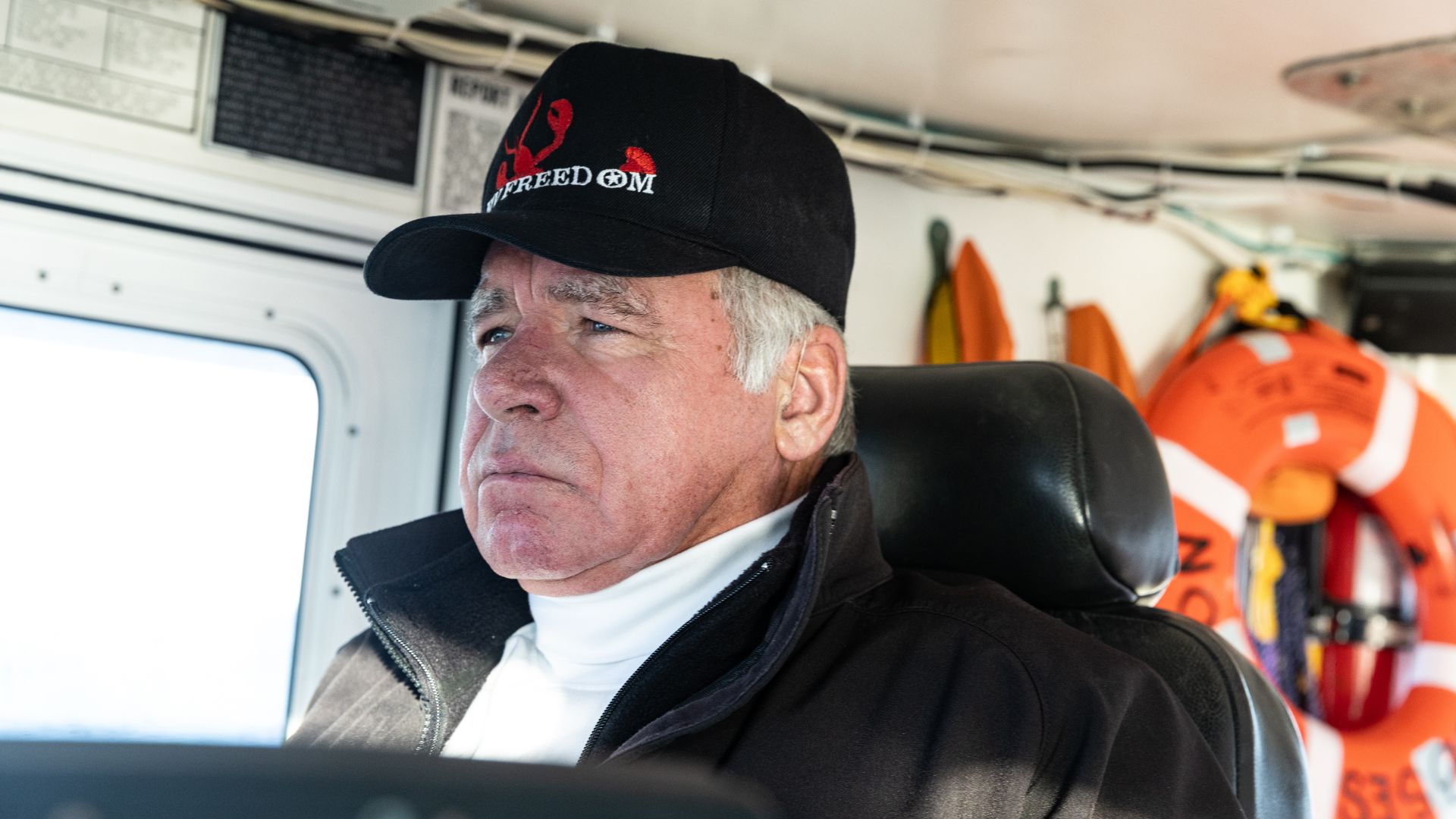
Frank has been lobstering for fifty-five years. “It’s something that’s born into you, the way of life out here,” he says.
He lives in Vinalhaven, a small, rugged island that a nineteenth-century official once dismissed as a “huge mass of granite” unsuitable for agriculture. The island is a bustling lobster port that employs about 500 people. (The total population of Vinalhaven is 1,200.)
Frank has four boats: Obsession, Easy Rider, Independence, and Freedom.
He says trapping lobsters is unlike anything else. “A lot of people go fishing,” he explains. “But they don’t get the glory of catching. Each trap is like Christmas. You haul a trap over the side and if you get plenty of lobsters, it’s quite a gift.”
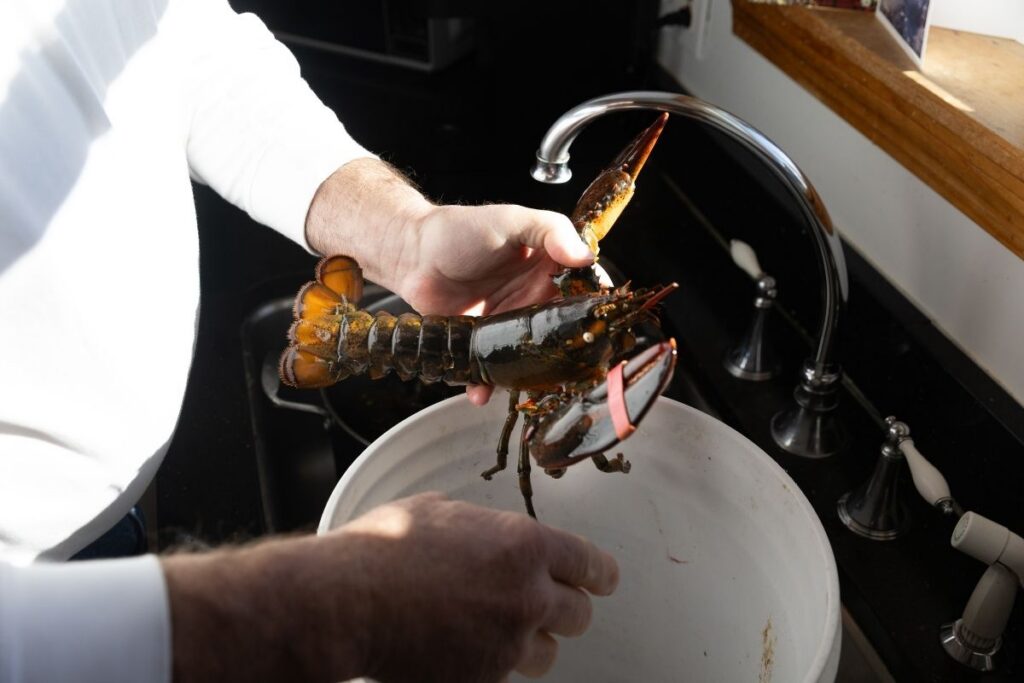
That part of the job—the glory of the catch—hasn’t changed. It’s everything outside the trap that’s different. “When we started, we had seven pages in a little handbook of rules and regulations,” Frank remembers. Now there are too many rules to count.
Here’s a big one: In December 2023, the Maine Department of Marine Resources ordered lobstermen to install 24/7 GPS tracking devices on their boats. “And the reason I don’t want to do it is because I’ve spent 60 years on the water,” Frank explains.
I know where lobsters are. And these young guys, they don’t steam as far as I do. They don’t know what I do. But if they put this black box together with the landings every day, they know where I’m fishing every second and every pound that I’m catching. And that’s going on tradition—taking my history, what I’ve learned, passed down to my kids if they want it, or anybody else I want to give it to.
Surveillance doesn’t pause when lobstermen are off the clock. “No matter where I am, what I’m doing, you’ve got to be tracked,” Frank says. “Even if I’m out on a picnic with my family.” When you live on an island, your boat is like your car. You use it for fun, for chores, for emergencies. When Frank’s daughter-in-law went into labor, the family packed her onto a boat and zoomed her across the bay to the mainland. All Frank’s trips will now be tracked. If he refuses, he’ll lose his lobstering license.
This rule didn’t start with Maine. An interstate fisheries commission, backed by federal statute, ordered states to start surveilling lobstermen in 2022. The commission was first chartered by Congress in 1942 “in recognition that fish do not adhere to political boundaries.” A 1993 law made its power binding.
Now the rules pushing in on lobstering are multi-layered and unending, coming like the tide.
“It’s just ridiculous how an industry that’s been around forever gets over-regulated until they draw people out of it,” Frank says.
Before the Revolution
The Fourth Amendment to the Constitution protects Americans from warrantless search and seizure. It’s a protection the Founders insisted on because of what happened on the New England coast before the Revolution.
The wharves were under constant surveillance in the 1750s and 1760s. British customs officials patrolled the coastline, boarding ships and raiding warehouses to hunt for smuggled goods. They didn’t need probable cause. Customs officials carried “writs of assistance,” general warrants that listed no suspect, address, cargo, or crime. The writs were an open invitation: Officials could enter private property at will.
New England merchants and fishermen—who caught cod that was then salted, packed in barrels, and traded with the West Indies for molasses—hated living under the constant harassment of British officials. In 1761, a group of Bostonians hired a young lawyer, James Otis, to argue against the writs.
On a cold day in February 1761, Otis stood in the Old Boston Statehouse. He spoke for five hours straight.
“I will to my dying day oppose with all the powers and faculties God has given me, all such instruments of slavery on the one hand, and villainy on the other, as this writ of assistance is,” he declared.
It appears to me the worst instrument of arbitrary power, the most destructive of English liberty and the fundamental principles of law, that ever was found in an English law book.
A special writ to search a specific ship would be different, Otis argued. But constant surveillance, a wide net cast over the coastline, is a dangerous form of “petty tyranny.”
John Adams was in the audience watching Otis’s speech. Nearly sixty years later, in a letter to a friend, Adams still marveled about that day. Otis was “a flame of Fire!” he wrote. “Then and there the child Independence was born.”
Supreme Court justices have long recognized the Fourth Amendment as the Founders’ direct response to the writs. The words of the Fourth Amendment “are precise and clear,” Justice William O. Douglas wrote in Stanford v. Texas (1965).
They reflect the determination of those who wrote the Bill of Rights that the people of this new Nation should forever “be secure in their persons, houses, papers, and effects” from intrusion and seizure by officers acting under the unbridled authority of a general warrant. Vivid in the memory of the newly independent Americans were those general warrants known as writs of assistance under which officers of the Crown had so bedeviled the colonists.
Yet 250 years after the Revolution, in the same New England waters where British customs officials once brazenly searched colonists’ ships, the government is insisting on indiscriminate surveillance of everyone with a lobster boat.
“It is supposed to be a free country,” Frank Thompson points out.
Petitioning the Supreme Court
In March, Pacific Legal Foundation asked the Supreme Court to hear Frank’s lawsuit against the surveillance rule. “This case presents important Fourth Amendment questions about trespass on and constant surveillance of private property used for both commercial and noncommercial purposes,” we told the Court.
Frank is grateful for the support.
“When I got the call that Pacific Legal was going to take a case for nothing, it was just like Christmas,” he says.
It still galls him that the GPS devices track lobstermen even when they’re not working. Frank uses his boat to do things for people in the community—to take someone to the hospital or tow in a broken boat. “You never know where I’m going to be any given minute of the day,” he says.
Somebody calls me on the phone, I just jump the boat and go help whoever. But I don’t think it’s any of the state or federal government’s business what Frankie Thompson does for other people.