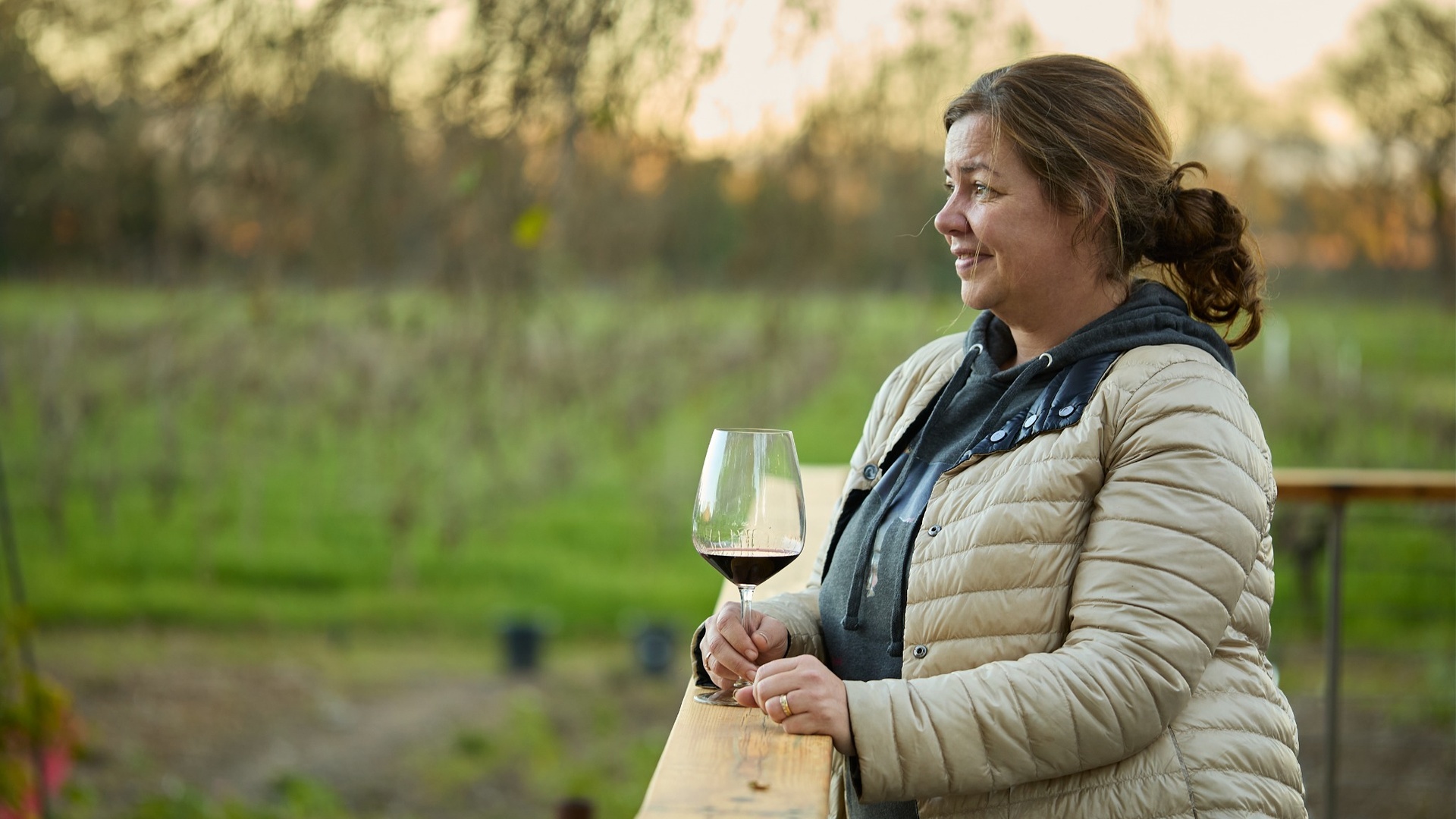

Not everyone would spend two days touring a scraggly camera crew around their Napa vineyard, but Lindsay Hoopes isn’t everyone. She’s a quick-witted mother of four and former assistant district attorney who specialized in prosecuting gang violence.
She’s also a small business owner facing nearly $4 million in fines for hosting wine tastings. At her licensed winery.
When I first met Lindsay, she was hustling up the long-paved driveway to the historic barn she’d elegantly converted to a tasting room at her family’s vineyard. She was nothing like I expected her to be. I had an idea of Napa as a magazine spread come to life—everything soft and cream-colored, women in palazzo pants and tiny jewelry. Lindsay wore a puffy outdoor jacket and plain dark jeans. The only hint of the glamour I associate with Napa was her large custom “Hoopes” hoop earrings.
Our Pacific Legal Foundation crew traveled to Hoopes Vineyard to document Lindsay’s story. She was in danger of losing everything in sight—the vineyard, her entire family business—because of Napa County’s excessive fine for hosting wine tastings. We already knew the facts of Lindsay’s case, so our first look at her vineyard was bittersweet. I thought: All of this could be taken away.
The total judgment is more money than Hoopes Vineyard made from tastings in its 40 years of existence.
It was raining. The crew was frazzled and worried about getting their equipment wet. While they set up, Lindsay took a couple of us on a tour around the vineyard.
“I grew up in Napa,” she told us. “My family moved here when I was a year old, and I grew up in the wine industry.” She worked at her father’s winery but never thought she’d take it over. “I was just like any teenager. I spent a lot of my childhood wanting to leave and never come back.”
She left California for college and returned to study law at UC Law San Francisco. Then she spent eight years as an assistant district attorney in San Francisco, working on gang cases and domestic violence—the tough ones where no one wants to testify. “I was an evidence expert, basically,” she explained.
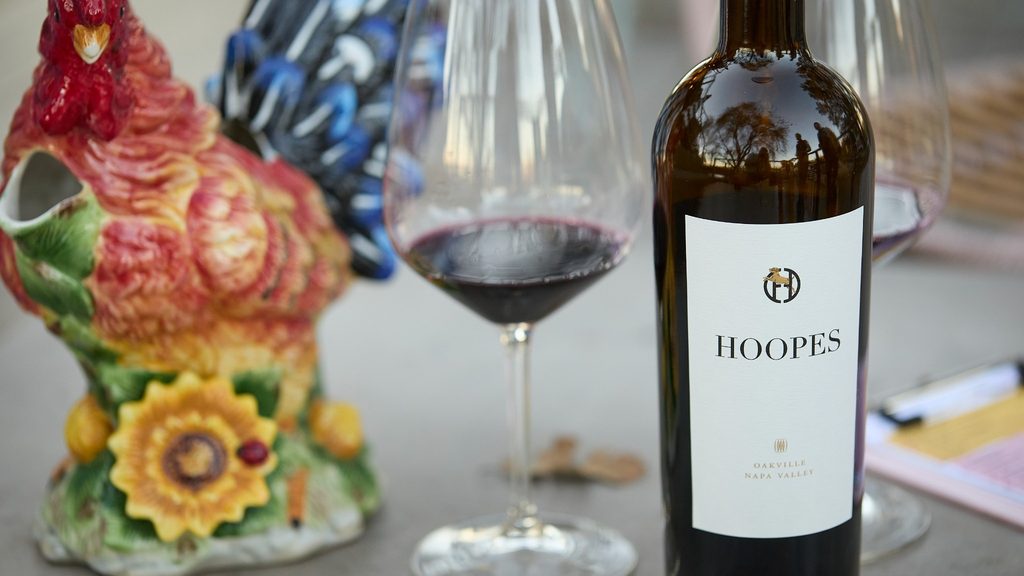
Only when her father faced a life-threatening illness did she return home to Napa. As her father stabilized, she decided to embrace a new challenge and expand the family winery. She bought another small winery, Hopper Creek Winery, and renovated its old barn into an “Oasis” where visitors could enjoy the gorgeous views of grapevines twining around trellises before rolling green hills.
That’s what we were now walking through: the Oasis Lindsay built. The design of the renovated tasting room synthesizes with its natural surroundings. The gardens are brimming with flowers, artichokes blossoming, lime trees, and strawberries hanging down from garden beds. The patio opens into a tasting room, cellar, and production area, with the intention that guests could visit and enjoy a glass of wine and embrace “the Napa lifestyle” close to where their food and wine is grown.
“When I was growing up in Napa, it was agriculture first,” Lindsay said. “It was very family friendly, and it was about connecting to the place and enjoying the agricultural products from that place in the place and connecting with the people behind it. So I wanted to recreate the farm that I sort-of grew up in.”
The Opposition
Lindsay’s problems with Napa County began with the foundation pour and haven’t stopped.
Before starting her renovation, Lindsay went through the proper channels. She obtained a flood plain permit and approval to pour a new foundation. Then Napa turned around and asked her to raise the foundation by a foot. This is obviously impossible without major structural work. So, Lindsay hired an engineer, at great personal cost, to configure flood doors that would meet Napa’s new demands.
Lindsay led us through the flood doors, back through an elegant cellar with a long table, made of reclaimed redwood. The smell of the oak casks fermenting delicious wine filled the room. I understood Lindsay’s vision. The property is a revelation, a celebration of the synergy between nature and humanity, when they exist in tandem.
Through another door were the tank rooms and apparent laboratory equipment involved in winemaking. It’s not as simple as mashing up some grapes in a barrel. Even managing the wastewater involves a host of permits to meet sanitary and environmental standards.
Out back, Lindsay showed us where Napa demanded she dig up their septic system four times—each time refusing to listen to the septic contractors who verified everything was functional and up to code.
Listening to Lindsay describe this experience, you could hear the exasperation in her voice. Every time they had to dig up that system, it cost her small business $10,000 and the massive delays resulted in even more revenue loss.
As I was learning, winemaking is one part farming, one part chemistry, and a third part dealing with petty bureaucrats.
Cluckingham Palace
Everywhere around the small winery there are monuments to Napa’s persecution of the Hoopes family.
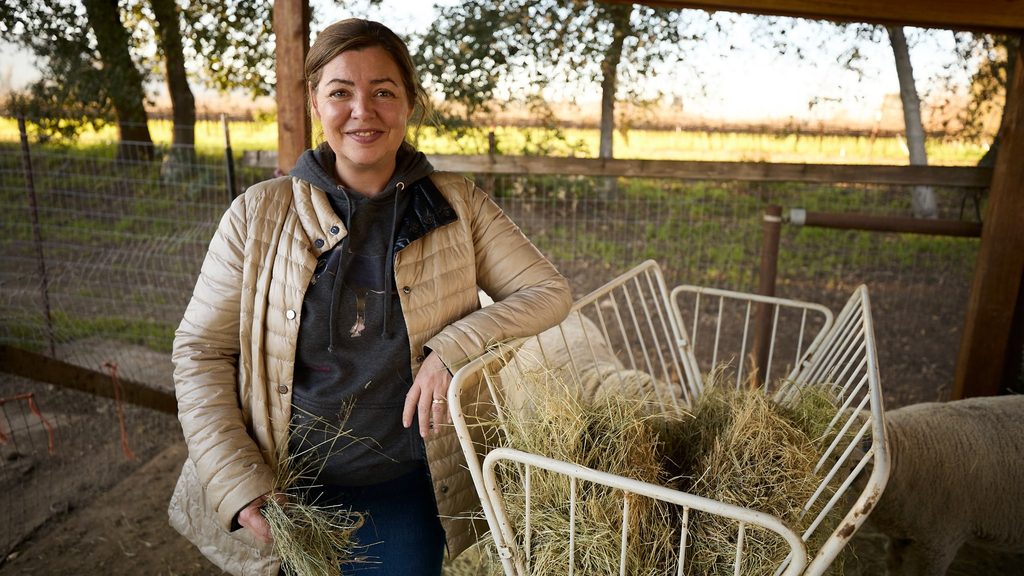
It cost the Hoopeses $20,000 to figure out flood plain permitting for the chicken coop, known to the family as “Cluckingham Palace.”
Napa required Lindsay to build three ADA-accessible bathrooms, two right next to each other, and another upstairs—even though, in the rather small building, one should have sufficed.
Napa required a flood permit to put solar panels on the roof. The Oasis couldn’t have string lights or yoga classes. Lindsay’s menagerie of rescued farm animals came under fire when Napa claimed they constituted a petting zoo—despite the fences protecting them from visitors.
As she explained the bureaucratic obstacle course Napa dragged her through, I kept waiting for Lindsay to explain that she’d finally decided to sue the County to contest one of these ridiculous rules. But through it all, Lindsay tried to comply with Napa’s ever-changing demands. She turned off the string lights, applied for the permits, and split Cluckingham Palace into two pieces to comply with Napa’s wishes. Throughout every aggravating permitting situation, she kept her cool and collaborated. Like most of us, she didn’t want to provoke her local government.
But despite her cooperation, Napa seemed determined to shut Hoopes Vineyard down.
Wine Tastings
In 2022, the County filed an enforcement action against the winery. It claimed Lindsay’s Small Winery Exemption didn’t allow her winery to host wine tastings—even though it can legally produce and sell bottled wine and see an unlimited number of retail customers.
“I don’t think that there’s anybody in this industry that doesn’t understand that in order to sell wine, people have to taste it,” Lindsay told me as we sat in her empty tasting room. “Customers don’t come here to not taste wine. So that means they won’t come. And that means not only do I not have the revenue of them coming, but they’re not going to buy my wine here or anywhere else, because they want to taste it.”
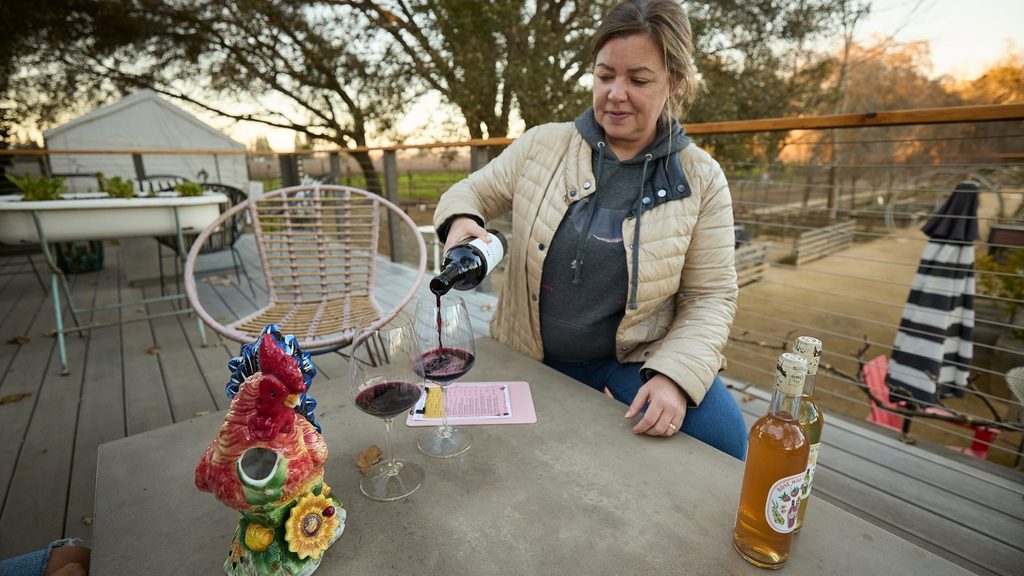
Napa started hosting wine tastings for this exact reason. The experience that the scenic valley a few miles north of the bay offers visitors is more of a draw than a bottle gathering dust in a wine shop.
And, confusingly, Napa already signed off on Hoopes’s Alcohol Beverage Control permits with the State of California. An official from the alcohol licensing board already marked out where customers were allowed to drink alcohol on the property. ABC had to verify their alcohol permits complied with local land use law, and Napa signed off on Lindsay’s ability to serve wine on the premises.
In other words, Napa knew the Hoopeses intended to have wine tastings at their winery. Virtually everyone in Napa is having wine tastings at their wineries.
Small Winery Exemptions date back to the 1980s: They allow small wineries to operate without having to endure the full permitting process that larger vineyards go through. Vineyards with SWEs have hosted wine tastings for decades.
But now Lindsay, with the same exemption, is treated like a criminal.
A Cruel County
When Lindsay gave birth to her twins, they had to stay in the NICU for weeks. “And that was precisely at the time when Napa County tried to shut us down,” Lindsay said.
And I remember asking them, you know, can you wait a couple weeks to have this hearing? Because it seems like what could possibly the urgency be? But I’m in the hospital with the children in the NICU and Napa was like, no, no, we need to shut her down right now.
At this point in Lindsay’s story, my jaw was on the floor. I’m familiar with how the government hurts our clients, stealing their property, ignoring the limits of its own power, but this was heartlessness on a new level. As Lindsay told the story, her twins, now toddlers, climbed over her and attempted to escape into the vineyards. It struck me: All the time Lindsay spent on panicked calls with her legal team, finding paperwork, trying to save her business, was time she could have been spending with her family. When the government comes after you, it robs you of more than money; it robs you of a peaceful life.
After an eleven-day hearing, a stunning judgment of $3,960,013.05 was entered against Lindsay. Only $1.5 million of this was an actual fine. The rest covered the County’s private attorneys’ fees.
The total judgment is more money than Hoopes Vineyard made from tastings in its 40 years of existence. The County’s counsel commented that Lindsay should “welcome bankruptcy.”
PLF now represents Lindsay in a lawsuit challenging the County’s excessive fine as a violation of the Eighth Amendment. A punitive fine can’t be outsized to the offense; it can’t be a hammer to frighten people into compliance. And here, not one person was harmed by the allegedly illegal wine tasting.
The lawsuit is ongoing. Meanwhile, the County is pushing to collect.
You’d think Lindsay would be furious at what’s happening to her. None of it makes sense. Her family’s future hangs on the whim of bureaucrats with an appetite for destruction.
But Lindsay seemed more sad than angry.
“Business owners who are taxpayers? They shouldn’t be afraid of their own government,” she said.