When architect Howard Roark is put on trial at the end of Ayn Rand’s The Fountainhead, he at least did something to deserve it. He destroyed a building he designed because “second-handers”—people who live through others while creating nothing original themselves—corrupted Roark’s design. Even after he blows up the building in spectacular fashion, Roark is given a fair trial where he’s allowed to make his case to a neutral jury.
Compare this with the real-life story of Jeffrey Hagen, a California architect. Jeffrey Hagen destroyed no buildings. He harmed no one. He is fully licensed to practice architecture in California. His offense, according to the State of Nevada, is submitting design drawings for a Las Vegas remodel two weeks before he applied for license reciprocity with the Nevada State Board of Architecture.
For that, Jeffrey was hauled into the Board’s in-house tribunal, denied a jury, and fined $29,610.64.
You love your work. God help you, you love it! And that’s the curse. That’s the brand on your forehead for all of them to see.
Henry Cameron to Howard Roark in The Fountainhead
Back in school, Jeffrey says, “I never considered myself a scholar or exceptional” until he took architecture classes. “I wasn’t the top in anything—but in architecture, I was.”
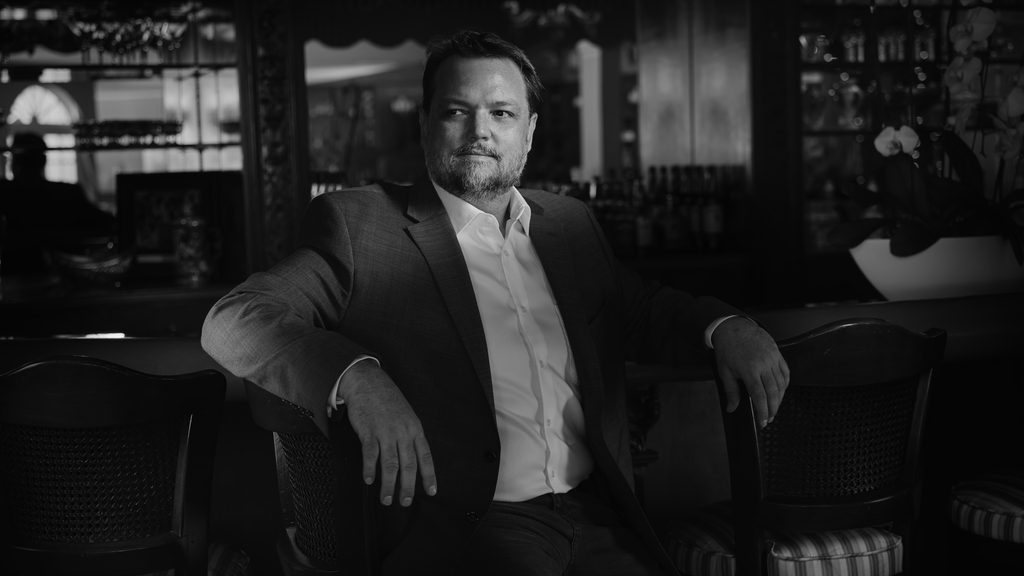
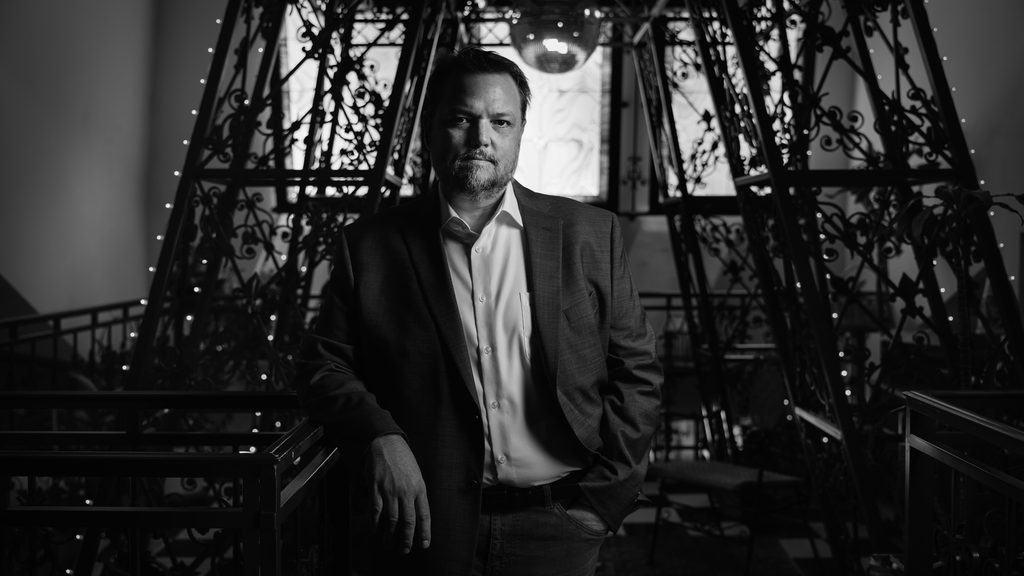
Jeffrey Hagen at the Phyllis McGuire home. (John Michael Cooper)
When you’re designing a building for people to live or work in, you’re negotiating a flood of information: how rooms fit together, how people might move through them, the near-infinite possibilities of design. “You get information in all forms,” Jeffrey explains. “You get it in written form, in code form, in drawing form, on the actual site.” He has built apartment buildings, offices, warehouses, hotels, and homes. To design an apartment building, he says, you need to figure out how to layer studios, one-bedrooms, and two-bedrooms across multiple floors. (“Each part has to be just right.”) With a warehouse, you first study how an 18-wheeler moves around a parking lot. (“You really start understanding they’re going to reverse out their left shoulder, so everything is going to be left-shoulder reversed…”)
It is, each time, a new puzzle. Whenever he’s on a project, Jeffrey says, “I bring in all the information and let it filter through my brain, and then into the drawings.”
One of these conceptual drawings is what got him in trouble with the government.
It was not malice. It was not a judgment passed upon his merit. They did not think he was worthless. They simply did not care to find out whether he was good.
The Fountainhead
There is a house in Las Vegas that belonged to the singer Phyllis McGuire, from the popular 1950s trio The McGuire Sisters. It is a legendary house: Phyllis lived there while dating Sam Giancana, the flashy mafia boss who once partnered with the CIA in a failed attempt to poison Fidel Castro. The house has a 40-foot replica of the Eiffel Tower in the living room and a mirrored floor in the dining room. The front windows are bulletproof.
Jeffrey has a longtime client—“the greatest guy in the world”—who is always coming to him with plans for new building projects. “Some of them go forward and some of them don’t,” Jeffrey says. That’s the nature of the business. Every building starts as an idea: What if we could do this…
The client was interested in the Phyllis McGuire home. Before he committed to buying it, he wanted Jeffrey to kick around an idea for a slight remodel. He didn’t want to change much about the house. “It was just a few interior walls that he wanted to move around,” Jeffrey says. “The project was the simplest thing I’ve ever done in my career.”
Jeffrey drew up the redesign. The client, satisfied, bought the house. Then he asked Jeffrey to move forward with the remodel, starting with the permitting process. Jeffrey submitted his drawing to the Las Vegas Building Department, clearly identifying himself as a California architect. Then, two weeks later, he filled out Nevada’s reciprocity application, which allows architects with out-of-state licenses to apply for permission to practice architecture in the state.
One question on the application asked whether he’d already prepared drawings for a client for any project located in Nevada. Jeffrey checked the “yes” box.
Not long afterward, an investigator from the Nevada State Board of Architecture called.
The ‘common good’ of a collective—a race, a class, a state—was the claim and justification of every tyranny ever established over men.
— Howard Roark in The Fountainhead
The investigator wanted to see Jeffrey’s drawing. Jeffrey sent her a copy.
“When they brought it up, I’m like, okay—but I’m coming to you and applying for the license now,” Jeffrey says. “I mean, that’s what I’m doing now.”
The Board promptly charged Jeffrey with practicing architecture without a Nevada license. Jeffrey was given the opportunity to settle the matter for $2,300 if he admitted criminal guilt.
He refused.
“Their interpretation is I’m not allowed to make a drawing without being licensed in their state,” he says. “It didn’t seem right.”
He tried to withdraw his application and back away from the project. That wasn’t enough. “They still kept coming after me,” he remembers. “I said, ‘Listen, I’ll pay a fine and just do an informal letter to say I’m sorry or something like that.’ No, you’ve committed a crime. And every step forward when I thought I was negotiating it, basically they were just doubling down.”
Jeffrey has been an architect for over 20 years. “I just work hard,” he says. “I study the code, I communicate, and I’ve always thought that should be enough.” He has seen projects held up or killed in the permitting phase. “Everybody has their little pound of flesh they take from the project.” This was different. The Nevada Board was reaching across state lines to criminalize an honest drawing, the product of his own mind. It was an exercise in brute force without reason, punishment for an idea.
“I’m not a wallflower or a spring chicken,” Jeffrey says. His approach to his work—exploring a project in a conceptual drawing, communicating openly with stakeholders—is what makes him a good architect. “You’re not allowing me to be a good architect.”
When Jeffrey refused the settlement, the Board held an administrative hearing at its own office in Las Vegas. The hearing was conducted by the Board’s own counsel and overseen by the Board’s members. There was no jury.
Jeffrey was found guilty. The Board fined him $20,000 in civil monetary penalties—$10,000 for practicing architecture without a license, $10,000 for “holding himself out as a Nevada architect”—plus $9,610.64 to cover the Board’s costs and attorneys’ fees.
What can you do now? You can’t sue the government.
— Peter Keating to Howard Roark in The Fountainhead
Jeffrey sued the government.
He filed a lawsuit against the Nevada Board of Architecture for denying him his right to a jury trial, a fundamental right protected by both the Nevada Constitution and U.S. Constitution. Pacific Legal Foundation took over his case on appeal to the Nevada Supreme Court.
The court held oral arguments in June.
“This case presents an important constitutional question: whether the government may impose punitive civil monetary penalties without a jury,” PLF attorney Cameron Halling said in his opening statement.
The government’s attorney tried to argue that the Board punished Jeffrey Hagen “to protect the citizens of the state of Nevada.” One judge, at least, was unconvinced.
“Let me just stop you right there, counsel,” Judge Patricia Lee interjected.
So to protect the citizens of Nevada—here’s a guy who had plans. He’s a California licensed architect. He stamps the plans with his California stamp. So he’s not trying to—I would assume he’s not trying to deceive anybody. He didn’t make up a fake Nevada stamp, right? He submitted it…Like, what was the protection of the public? There was no harm.
Judge Lee also pressed the Board’s attorney on the penalty: How did the Board arrive at the number $29,610.64, after Jeffrey previously refused an offer to settle at $2,300?
“Allow me to just sort of put this in context,” the attorney began. He explained that the Board employs a full-time investigator “who does nothing but police unlicensed practice in Nevada.” Penalties are calculated to deter others, he said. “What our boards do is teach, okay, through our discipline—through administrative actions.”
“So it wasn’t necessarily commensurate with what he did,” Judge Lee pointed out.
It’s just like, Hey, here’s an example. We’re trying to deter other people from doing it. And so that brings me back to my point. Does he have a right to have an independent, disinterested jury—who doesn’t have those same motives in mind—review his case?
The court’s decision is now pending.
It doesn’t say much. Only ‘Howard Roark, Architect’ But it’s like those mottoes men carved over the entrance of a castle and died for. It’s a challenge…
Henry Cameron to Howard Roark in The Fountainhead
Jeffrey took himself off the Phyllis McGuire home renovation. He found and vetted another architect for his client, who was frustrated but understood. They would do other projects together.
Jeffrey talked to other architects and engineers about what Nevada was doing to him. “I put it in the most objective, non-emotional way to people to get their opinion,” he says. “I asked contractors that I work with, ‘Hey, this is what happened. What do you think?’” They rolled their eyes and told him similar stories. Half advised him to just pay it. “Everybody says it sucks”—but just pay it and be done, some said. The other half told him to fight it.
That’s what he’s doing. “I’m not one to back down from a fight,” he says. “It’s just not a fight I would’ve preferred.”
Jeffrey remembers that back when he graduated architecture college, he rushed to take California’s exams. He knew he couldn’t legally call himself an architect without a license. “You’re not going to tell me I’m not an architect,” he remembers thinking. He’s been licensed since 2001.
He still can’t believe the Board turned a simple remodel into this legal ordeal. His career is about creating. The Board’s pursuit has created no value. It is a subtraction, a senseless negative.
Discussing his lawsuit with PLF, Jeffrey admits he doesn’t know much about how lawsuits work. “If you come to architecture, I can tell you where all the potholes are and I can guide you through it,” he says, “But I don’t know the legal system. So all I can say is, I hope you crush them.”
Sword&Scales brings you stories from real legal fights defending constitutional rights—beautifully designed, four times a year, delivered to your door.
Support Pacific Legal Foundation with a gift of $25 and we’ll send you a full year of Sword&Scales—all four issues, in print.